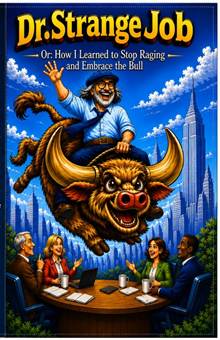
Who is Dr. StrangeJob and how will he save the CB economy?
To begin: I am not, nor have I ever claimed to be, anyone other than the person I am currently pretending to be.
So who is Dr. StrangeJob, and what is his elaborate plan to save the Cape Breton economy?
First and foremost, Dr. StrangeJob is not a liar, but he does admit to being prone to excessive recklessness with the truth. That said, he considers himself to be a noble man, one with countless years of dedicated service in various world peace initiatives. In his youthful years, he was considered by many to be quite the prize, and to this day, he still fancies himself a winner. In other words, Dr. StrangeJob is Cape Breton’s first and foremost Noble Peace Prize Winner.
There are many exploits that could be shared about the good Doctor, but paramount to his current plan to save the Cape Breton economy is in recognizing his visionary approach that ultimately spawned Incompetents Anonymous – the World’s first 12+1 Step self-help program.
So, just how does Dr. StrangeJob plan to save the Cape Breton Economy? In two words – Akron Ohio
Yes, that Akron, Ohio, otherwise known as the birthplace of Alcoholics Anonymous (AA) That’s right, what Dr. Bob S. did for Akron, Dr. Dan S. plans to do for Cape Breton. Do you have any idea how many tourists travel yearly to Akron to attend meetings, view historical landmarks, buy trinkets, rent lodgings, and eat at local restaurants? Just imagine, the busloads (heck, maybe container loads) of new tourists spending all of their money just to visit the birthplace of Incompetents Anonymous.
Sure, the idea may seem pie in the sky, but the Doctor has a plan. In fact, he has a 12+1 Step plan, and he has already invested a considerable amount of his personal time and money into the development of a world class marketing and membership drive. He does realize, however, that we must take the process one step at a time, and that the first step is the most vital.
That is why, and upon immediate press release, the Doctor will work with all key CBRM stakeholders, the various levels of government, and local educational institutions in support of the development and creation of “The Cape Breton Centre of Excellence – Incompetents Anonymous”. Just imagine the marketing slogans for that one!
This is what we do best. Just look at the abundance of natural resources we have in politics alone.
Visit Cape Breton for the beauty, stay for the incompetence.
So ends Part I of the continuing saga of Dr. StrangeJob – Savior of CBRM
Dr. StrangeJob
Dr. StrangeJob is a satirical blogger, retired educator, social activist, actor, screenwriter, creator of Incompetents Anonymous (IA), and leader of the CBLA-InComps. He can be reached at drstrangejob@gmail.com. Follow him on Bluesky or Facebook @drstrangejob.
Buy my new book on Amazon by searching for Dr. StrangeJob.